
The Radical Chemistry of Chlorine Dioxide
Chlorine dioxide is a powerful oxidizing agent whose effectiveness stems from its molecular structure: a single unpaired electron that drives selective oxidation of microbial targets. Unlike chlorine, ClO₂ remains stable in solution and its efficacy is largely independent of pH. This page explains the mechanism, from molecular contact through cellular inactivation.
A Better Oxidizer With Fewer Byproducts
While chlorine and chlorine dioxide are often discussed together in disinfection chemistry, their physicochemical properties diverge significantly. Chlorine ionizes in aqueous solution, forming hypochlorite and hypochlorous acid. Its oxidizing capacity is pH-dependent, with effectiveness declining substantially above neutral pH. Additionally, chlorine exhibits non-selective reactivity with dissolved and particulate organic matter, generating disinfection byproducts including trihalomethanes.
Chlorine dioxide remains molecular in aqueous solution rather than ionizing. Its oxidizing potential is substantially independent of pH, maintaining efficacy across a wide operational range. Critically, ClO₂ exhibits selective oxidation, targeting specific amino acid residues in microbial proteins rather than reacting indiscriminately with organic compounds in the water matrix. This selectivity minimizes byproduct formation.
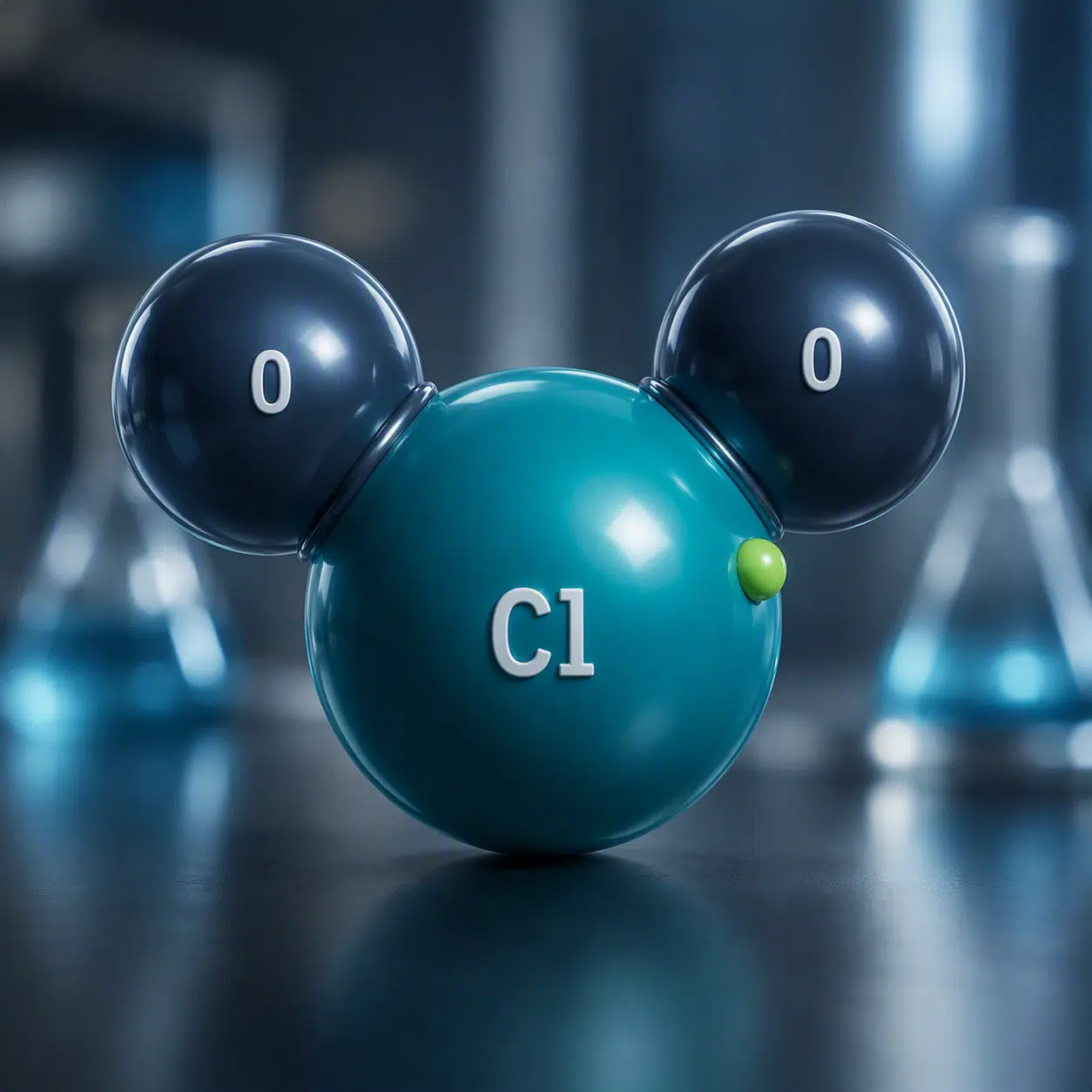
Watch it work, one step at a time.
Click through the mechanism below. The oxidative pathway applies consistently across bacterial cells, viral particles, and resistant structures such as spores and protozoan cysts.
Molecular Transport
Chlorine dioxide, existing as a neutral molecule in aqueous solution, penetrates cellular and biofilm barriers more efficiently than ionized disinfectants, enabling direct access to microbial targets.
Key Performance Characteristics
Broad-Spectrum Activity
Bactericidal, virucidal (including non-enveloped viruses), fungicidal, and sporicidal across a wide range of pathogenic organisms.
Material Compatibility
Minimal corrosion on stainless steel and acrylic systems compared to oxidizers that generate free chlorine or lower-pH solutions.
pH-Independent Efficacy
Maintains consistent oxidizing potential across pH 4–9, unlike chlorine-based disinfectants whose effectiveness is highly pH-dependent.
Occupational Safety Profile
Measured airborne concentrations during preparation and handling remain within established occupational exposure limits under standard ventilation.
Safe for stainless steel systems.
Unlike chlorine-based disinfectants, chlorine dioxide exhibits minimal corrosion on standard materials found in water treatment infrastructure.
| Disinfectant | 304 SS Weight Loss | Thickness Change |
|---|---|---|
| ClO₂ (Aseptrol S10 Tablets) | -0.002g | None |
| Acid-Activated Chlorite | -0.003g | None |
| Chlorine Bleach (5250 ppm) | -0.021g | +0.003" |
14-day immersion test on 304 stainless steel coupons at room temperature. Data: Sensible Science Aseptrol S10 Materials Compatibility Study.
The corrosion difference is substantial. Chlorine dioxide solutions (whether from tablets or acid-activated chlorite) caused minimal measurable degradation of 304 stainless steel. Weight loss averaged 0.002–0.003 grams across a 14-day exposure cycle, with zero dimensional change.
By contrast, diluted chlorine bleach (1:9 with water) caused average weight loss of 0.021 grams and measurable thickness increase due to scale formation, an average weight loss nearly 10x that of the ClO₂ solutions, consistent with an 85–90% reduction in corrosion weight loss for ClO₂ relative to bleach.
Practical implication: ClO₂-based chemistry can run through existing stainless steel piping, tanks, and equipment indefinitely without material degradation. Chlorine bleach requires frequent system inspection and eventual replacement of corroded sections.
This materials compatibility extends to other common system materials, with ClO₂ showing minimal reactivity compared to oxidizers that generate free chlorine or lower-pH disinfectant solutions.
ClO₂ vs. chlorine, side by side.
Chlorine (Cl₂ / hypochlorite)
- Ionizes in water; oxidation potential depends strongly on pH
- Exhibits non-selective oxidation of dissolved and particulate organic matter
- Effectiveness diminishes significantly at pH above neutral
Chlorine Dioxide (ClO₂)
- Remains molecular in solution; ionization does not occur
- Selective oxidation at specific amino acid residues in target proteins
- Maintains consistent oxidation potential across pH 4–9
Mechanism agnostic to microbial class.
Selective radical oxidation applies consistently across bacteria, viruses, and resistant morphologies including spores and encysted protozoans. The fundamental pathway does not substantially vary with target organism type.
Bacteria
Viruses
Bacterial Spores
Fungi
Protozoan Cysts
Minimal residual chemistry.
Following oxidative contact and electron transfer, chlorine dioxide reduces through chlorite to chloride ion, water, and dissolved oxygen. No persistent disinfectant residual or reactive intermediates remain in solution.